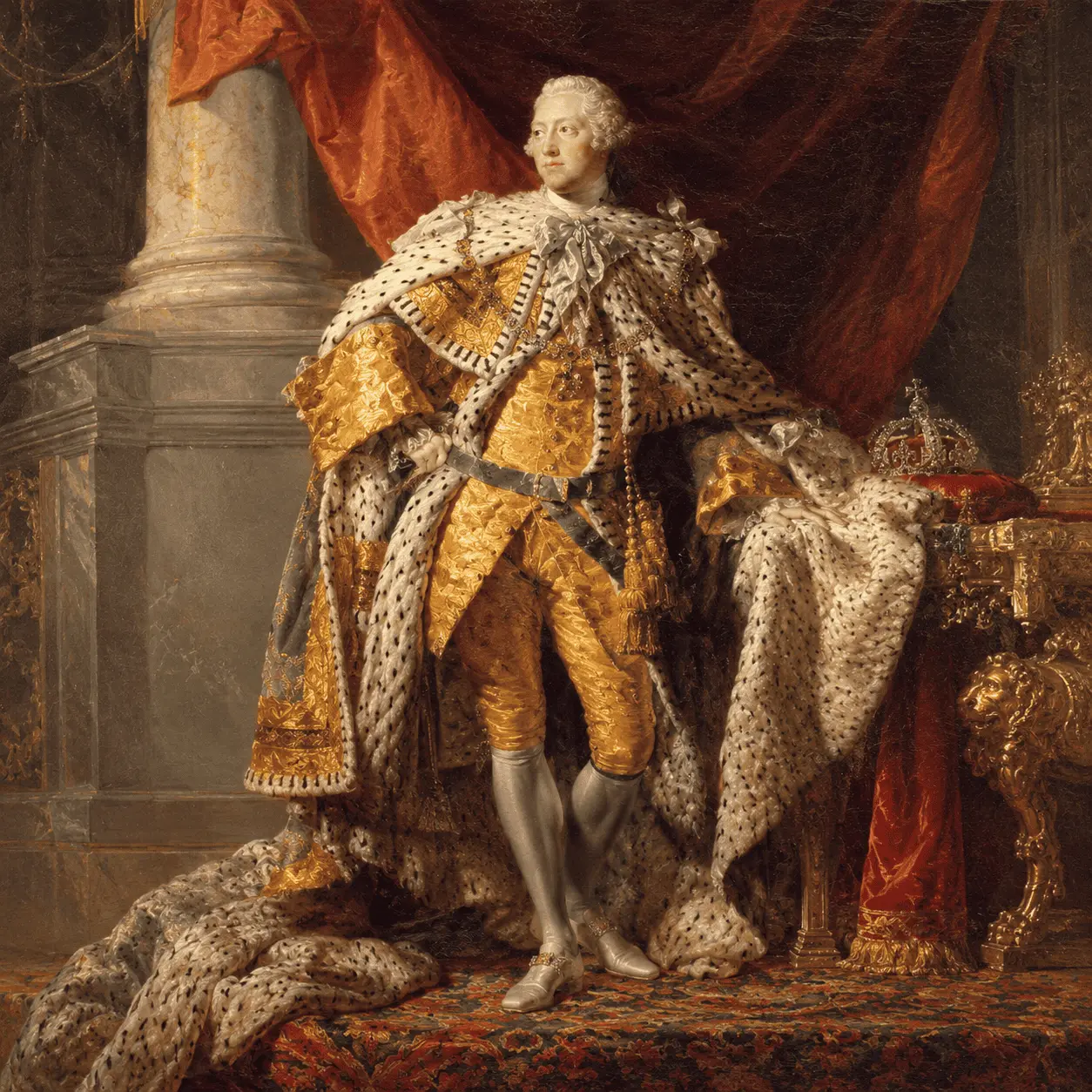
Loyalists were colonists who stayed faithful to the Crown during the American Revolution of 1775 to 1783. Perhaps one in five free colonists took that side. After Britain’s defeat, tens of thousands left, and those who went north founded New Brunswick, Upper Canada and much of English-speaking Canada’s political character.
Key facts
| Topic | Detail |
|---|---|
| Period | 1775 to 1783, with migration continuing to about 1790 |
| Share of colonists | Roughly 15 to 20 percent of the free population (estimates vary) |
| Departures | Around 60,000 to 80,000 left the new United States, by common estimates |
| Main Canadian destinations | Nova Scotia, the future New Brunswick, Quebec and the future Ontario |
| Honorific | “U.E.” (United Empire Loyalist), proposed by Lord Dorchester in 1789 |
Not every colony rebelled
The Revolution is often described as the quarrel of “the colonies” with Britain, but only thirteen did so. In 1763 Britain held many more provinces in the Western Hemisphere than those thirteen. Quebec, Nova Scotia, Newfoundland, the two Floridas and the British Caribbean islands never joined the rebellion. Some were cautious, some were indifferent, and in Nova Scotia many New England-born settlers sympathised with the Americans yet were too exposed to the Royal Navy to act.
Loyalty therefore had two forms. One belonged to whole provinces that simply stayed in the empire. The other was personal and costly, and it belonged to individuals in rebel colonies who refused to change sides and paid for it.
Who the Loyalists were
There was no single Loyalist type. Royal officials, Anglican clergy and merchants tied to British trade were prominent. Many were also farmers, craftsmen and recent immigrants, particularly Scots Highlanders in the Mohawk valley and in North Carolina, who had sworn oaths to the Crown. Dutch and German settlers in New York, Quakers who opposed war on principle, and people who feared that mob rule was replacing lawful government joined them.
Two groups deserve separate mention. Black Loyalists were enslaved people who accepted Britain’s offers of freedom, beginning with Lord Dunmore’s proclamation in Virginia in 1775 and renewed by the British commander Sir Henry Clinton in 1779. And many Indigenous nations, notably most of the Six Nations (Haudenosaunee) under leaders such as Joseph Brant, sided with the Crown because they believed it offered the better protection for their lands.
Why people left
As the war went on, Patriot committees and state legislatures passed measures against Loyalists: loyalty oaths, property seizures, fines, imprisonment and banishment. Outside the law there were riots, tar-and-feathering and burned farms. Some Loyalists took up arms in provincial regiments such as the King’s Royal Regiment of New York, Butler’s Rangers and the Queen’s Rangers, and they sought to go where those units were disbanded.
The Treaty of Paris, signed on 3 September 1783, recognised American independence, and its promise that Congress would “recommend” fair treatment of Loyalists was largely ignored by the states. The British evacuated New York City in November 1783, taking thousands of civilians. Ships sailed to Halifax, Saint John and Shelburne, and the migration continued for years.
Where they settled
| Region | What happened |
|---|---|
| Nova Scotia | Some 30,000 or more arrived by 1784; Shelburne briefly became one of the largest towns in British North America |
| New Brunswick | Created as a separate province in 1784 to give Loyalists their own government; Saint John received its charter in 1785 |
| Quebec and the Great Lakes | Thousands settled along the upper St. Lawrence, the Bay of Quinte and the Niagara peninsula |
| Grand River | In 1784 the Crown granted land to the Six Nations, led by Brant, who relocated from New York |
Black Loyalists founded communities such as Birchtown in Nova Scotia but faced discrimination, poor land and hard winters. In 1792 about 1,200 of them left Halifax for the new colony of Sierra Leone.
How Loyalists changed Canada
The Loyalist influx created enough English-speaking settlers in the old province of Quebec that the Constitutional Act of 1791 divided it into Upper Canada and Lower Canada. Upper Canada received British law for property and an elected assembly, and Lieutenant Governor John Graves Simcoe worked to build a society modelled on the monarchy and the established Church.
Loyalist communities, wary of republicanism after what they had endured, became the first strongholds of a political culture that valued the Crown and orderly change. Canadian historians continue to debate how much of that culture is owed to the Loyalists as opposed to French Canadians, Indigenous peoples and later immigrants. What is clear is that the Loyalist narrative helped establish the idea that Canada’s path differed from that of the United States. When the Crown became the foundation of confederation in 1867, it drew on an existing habit of loyalty. Read more on Canada and the UK monarchy and Canadian independence.
Descendants of those who qualified for “U.E.” status keep the tradition alive through the United Empire Loyalists’ Association of Canada. The monarchy’s Canadian history, including the Crown’s ties to Indigenous nations, remains a subject of lively discussion, as seen in the monarchy debate.
Related reading:
Frequently asked questions
What is a United Empire Loyalist?
The term was applied to American colonists who sided with Britain and settled in British North America. Lord Dorchester, governor of Quebec, announced in 1789 that they and their children could use the letters “U.E.” after their names.
How many Loyalists came to Canada?
Estimates vary. Historians commonly say about 60,000 to 80,000 Loyalists left the United States in total, and roughly 40,000 to 50,000 went to what became Canada, most of them to the Maritime provinces.
Were all Loyalists wealthy or well connected?
No. Officials and merchants were visible, but farmers, artisans, soldiers, free and enslaved Black people and Indigenous allies made up much of the migration.
Did most Loyalists leave the United States?
No. Historians estimate that a large majority remained and became American citizens, and many were quietly reintegrated after the war.
Sources and further reading
- Loyalists, The Canadian Encyclopedia
- United Empire Loyalist, Wikipedia
- Expulsion of the Loyalists, Wikipedia
- Loyalist (American Revolution), Wikipedia
Last reviewed: November 2026. Related reading: Queen Victoria and the Commonwealth.