Elizabeth II (1926 to 2022) was Queen of Canada from 6 February 1952 until her death on 8 September 2022, a reign of 70 years and 214 days. She made 22 official tours of Canada during her reign, opened Parliament in person in 1957, proclaimed the Constitution Act, 1982 in Ottawa, and was succeeded by her son, King Charles III.
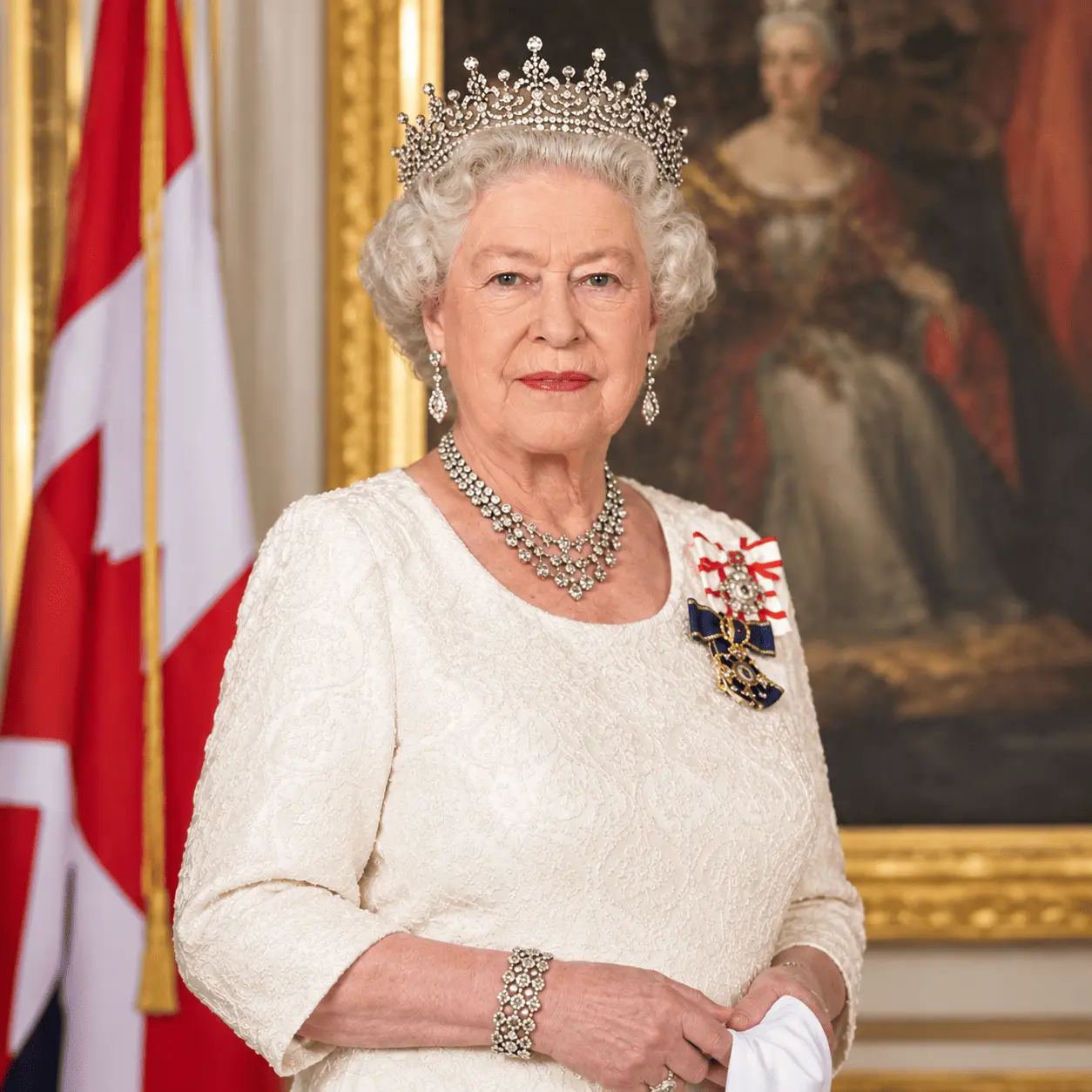
Key facts
| Born | 21 April 1926, London, as Princess Elizabeth of York |
| Accession | 6 February 1952, on the death of King George VI |
| Coronation | 2 June 1953, Westminster Abbey |
| Canadian title (1953) | Queen of Canada, within a single style shared with her other realms |
| Husband | Prince Philip, Duke of Edinburgh (married 20 November 1947; he died 9 April 2021) |
| Children | Charles, Anne, Andrew and Edward |
| Death | 8 September 2022, Balmoral Castle, Scotland, aged 96 |
| Length of reign | 70 years and 214 days, the longest of any British monarch |
| Canadian day of mourning | 19 September 2022 |
A princess who was not meant to be queen
Princess Elizabeth was born at a London townhouse in Mayfair, the first child of the Duke and Duchess of York. Nobody expected her to reign. Her uncle, Edward VIII, was young and unmarried, and her father was a shy second son. Then in December 1936 Edward abdicated, and the Duke of York became George VI. Ten-year-old Elizabeth became heir presumptive overnight, and the family moved into Buckingham Palace.
Her education was private and unusual for a future monarch. She studied constitutional history with the vice-provost of Eton, learned French, and absorbed the working habits of a sovereign by watching her father at his desk. Canada was already part of her family’s story. Her parents had toured the country in the summer of 1939, the first reigning King and Queen to do so, and travelled on to the United States. The visit is described in the 1939 royal tour. Her mother, later known as the Queen Mother, kept a lifelong affection for Canadians.
During the Second World War, Elizabeth broadcast to the children of the Empire at fourteen, trained as a mechanic and driver with the Auxiliary Territorial Service in 1945, and became the first female member of the royal family to serve full-time in the armed forces. In November 1947 she married Lieutenant Philip Mountbatten, a naval officer born a Greek and Danish prince. Their story is told in more detail in the profile of Prince Philip.
Accession in Kenya, coronation in London
In early 1952 Elizabeth and Philip set out on a Commonwealth tour, standing in for the ailing King. On 6 February, while they were in Kenya, George VI died in his sleep at Sandringham. Elizabeth became Queen at that moment, in Canada as everywhere else, because the Crown passes without a gap. She returned to London as sovereign.
Canada proclaimed its new Queen in Ottawa in the days that followed. It was an early demonstration that the Crown was no longer a single British institution that happened to extend overseas.
The coronation took place on 2 June 1953. Canadians watched on television for the first time in large numbers, and the Canadian Parliament had passed the Royal Style and Titles Act earlier that year to give her a title specific to Canada. Her Canadian title is covered in the page on royal style and titles, and the occasion is remembered in the coronation anniversary article.
The Queen of Canada: a reign in Canadian milestones
Her first visit to Canada was in October and November 1951, as Princess Elizabeth, when she toured the country with Philip and stood in for her ailing father. As Queen she returned again and again, in an unbroken series of visits that tracked the country’s own growth.
| Year | What happened |
|---|---|
| 1957 | First monarch to open the Canadian Parliament in person, and the first Speech from the Throne to be televised |
| 1959 | Opened the St. Lawrence Seaway with US President Eisenhower, and made a long tour of the country with Prince Philip. See the 1959 royal tour |
| 1964 | Marked the centenary of the Charlottetown and Quebec conferences |
| 1967 | Centennial celebrations in Ottawa on Dominion Day, and a visit to Expo 67 |
| 1970 to 1973 | Manitoba and Northwest Territories centennial, British Columbia’s centenary, Prince Edward Island’s centenary and a Commonwealth conference in Ottawa |
| 1976 | Opened the Montreal Olympic Games |
| 1977 | Silver Jubilee visit; delivered the Speech from the Throne again |
| 1982 | Signed the proclamation of the Constitution Act, 1982 on Parliament Hill on 17 April |
| 1997 | Newfoundland’s 500th anniversary of Cabot’s landing, and Canada Day in Ottawa |
| 2002 | Golden Jubilee tour of Nunavut, British Columbia, Manitoba, Ontario and New Brunswick |
| 2005 | Centenaries of Alberta and Saskatchewan |
| 2010 | Final visit: Halifax for the navy’s centennial review, then Ottawa for Canada Day |
The 1957 appearance mattered because it made explicit what the constitution says quietly. Parliament consists of the Sovereign, the Senate and the House of Commons, and the Queen of Canada came to Ottawa as the Queen of Canada. In her speech she spoke directly as Queen of Canada, in English and French, to the assembled members.
The 1982 ceremony was probably the most significant of all. On a rainy day she signed the proclamation that brought the Constitution Act, 1982 into force. It was the act that ended the last legal dependence on the British Parliament for constitutional amendments and added the Canadian Charter of Rights and Freedoms. A reigning Queen handing Canadians control over their own constitution is one of the less noticed symbols of the reign. The story of that sovereignty is told in the page on Canadian independence.
What she did in office
The Queen’s work in Canada was constitutional rather than political. She did not govern, and she did not intervene in elections or votes. In Canadian practice her powers are exercised by the Governor General on the advice of the Prime Minister and Cabinet, and she personally approved just a few things: appointments of Governors General, the creation of Canadian honours, and the content of the royal style. During her reign she appointed a dozen Governors General, starting with Vincent Massey in 1952, the first Canadian-born holder of the post. More about the office is on the viceroys page.
She also gave Canada an honours system with its own character. She was Sovereign of the Order of Canada from its creation in 1967 and of the Order of Military Merit and the Order of Merit of the Police Forces. The jubilee medals created for 1977, 2002, 2012 and 2022 are described in the awards pages.
Her relationship with the armed forces was personal. She held honorary appointments in dozens of regiments and served as Commodore-in-Chief of naval units. The wider relationship is the subject of the page on the armed forces. Canadian regiments of the Household Division, such as the Guards, had a particular connection to her.
Her Christmas broadcasts, carried each year on Canadian television and radio, reached millions, and the annual celebration of her official birthday in Canada, Victoria Day, became a national weekend.
Head of the Commonwealth
When she acceded, the Commonwealth had eight members. By her death there were 56, and the number of realms where she was Sovereign had grown and then contracted. Barbados became a republic in 2021, leaving her with fourteen realms besides the United Kingdom at the end. She travelled to every continent. She attended almost every Commonwealth Heads of Government Meeting, including the Ottawa meeting in 1973. Details are in the page on the Commonwealth.
Controversy and criticism
No reign this long is free from argument. The monarchy was tested by the aftermath of Princess Diana’s death in 1997, by the divorces and scandals of the 1990s, and by the 2020 decision of Prince Harry and Meghan to step back from royal duties. In Canada, critics argued that the monarchy was a colonial survival. Quebec’s sovereignty movement had little time for royal visits, and in 1964 some demonstrations accompanied her stay in Quebec City. Indigenous leaders pointed to the Crown’s treaty record and to injustices committed in its name. These debates continue, and the current state of opinion is set out in the page on the monarchy debate.
Even so, public respect for her personally was consistently higher than support for the institution. She never gave an interview and kept her opinions private, which allowed people of different views to see in her what they wished.
The last years
Prince Philip died on 9 April 2021, two months before his 100th birthday. The Queen sat alone at his funeral in St George’s Chapel because of coronavirus restrictions, an image that stayed with many Canadians. In 2022 she marked her Platinum Jubilee. Canada’s celebrations included a visit in May by the then Prince of Wales and the Duchess of Cornwall, who toured St. John’s, Ottawa and Yellowknife.
Her last constitutional act came on 6 September 2022, two days before her death, when she received the outgoing and incoming British prime ministers at Balmoral and appointed Liz Truss. The next day she sent a message of condolence to the victims of the stabbings in Saskatchewan, which became her last public statement.
Her death on 8 September 2022
Elizabeth II died at Balmoral Castle at 15:10 BST on 8 September 2022, aged 96. Her death certificate gave the cause as old age. King Charles III acceded at once. In Canada the Governor General, Mary Simon, and the Cabinet, with the Chief Herald of Canada, read the proclamation of the new King at Rideau Hall on 10 September 2022.
Canada in mourning
The federal government announced a 10-day period of mourning. Flags on federal buildings flew at half-mast, and landmarks across the country were lit in royal blue. Parliament and legislatures paid tribute, and books of condolence were opened in Ottawa and provincial capitals. Prime Minister Justin Trudeau said, in remarks reported that day, that she was “one of my favourite people in the world”.
Monday 19 September 2022, the day of her state funeral at Westminster Abbey, was declared a National Day of Mourning. It was a holiday for the federal public service, and other employers were invited to follow. That afternoon the Government of Canada held a national commemorative ceremony at Christ Church Cathedral in Ottawa, preceded by a memorial parade of members of the Canadian Armed Forces and the RCMP and a gun salute. She was buried that evening at Windsor, beside her husband, in the King George VI Memorial Chapel.
The memory lives on in public places. Many Canadian roads, bridges, parks and buildings carry her name, and the Queen’s statue project and the bells rung for her are among the lasting local tributes.
Her legacy
Elizabeth II’s importance for Canada rests on three things. She presided over the country’s transformation from a dominion that still looked to London to a fully independent state, without a break in constitutional continuity. She made the idea of a Canadian Crown real by appearing in person and speaking, in English and French, as Queen of Canada. And she set a standard of duty and restraint that her successor has tried to follow. Her son, the King, has said he would serve in the same spirit. His reign is covered on the list of sovereigns.
Related reading:
Frequently asked questions
How many times did Elizabeth II visit Canada?
Canadian Heritage counts 22 official tours during her reign, ending with her final tour in 2010. She also toured Canada as Princess Elizabeth in 1951.
When did Elizabeth II die and what was the cause?
She died on 8 September 2022 at Balmoral Castle in Scotland at the age of 96. Her death certificate listed old age as the cause.
What did Canada do on the day of her funeral?
The federal government declared 19 September 2022 a National Day of Mourning and a holiday for federal employees. A national ceremony was held in Ottawa while the state funeral took place in London.
What was her role in the 1982 patriation of the constitution?
She signed the proclamation of the Constitution Act, 1982 on Parliament Hill on 17 April 1982. The act gave Canada full control of its own constitution and added the Charter of Rights and Freedoms.
Who succeeded her as Canada’s sovereign?
Her eldest son became King Charles III on 8 September 2022 and was proclaimed King of Canada at Rideau Hall on 10 September 2022.
Last reviewed: November 2026
Sources and further reading
- Death and state funeral of Elizabeth II (Wikipedia)
- Reactions to the death of Elizabeth II (Wikipedia)
- National Day of Mourning in Canada to honour Her Majesty Queen Elizabeth II (Prime Minister of Canada)
- Commemoration for Her Majesty Queen Elizabeth II (Canadian Heritage)
- His Majesty King Charles III (Canadian Heritage)